


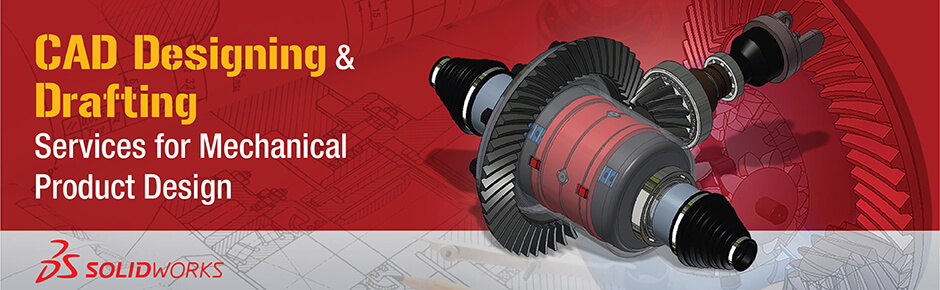
CAD drafting for mechanical product design accelerates product development by using detailed digital representations to create consistent documentation. Mechanical CAD design services facilitate collaboration across various stakeholders, enables rapid iteration, helps in scaling and offers smooth manufacturing handoffs.
Table of Contents
Mechanical product design is a challenge to scale internally within an organization. In terms of resources, organizations have difficulties with variability in document quality, lengthy development periods and manual drafting practices.
CAD drafting for mechanical product design provides the solution to these bottlenecks by providing standard digital processes for design. Professional mechanical CAD design services provide concept development as well as detailed design models and associated manufacturing documentation.
This helps to accelerate the design iteration cycle and ensure documentation accuracy. CAD design services enable engineering and manufacturing teams to collaborate seamlessly. Businesses get reduced time-to-market and consistency of design quality across all product lifecycle phases.
Role of CAD designing and drafting services in mechanical product development
CAD for mechanical design is the backbone that provides the precision and the common language among all members on an engineering team.
Mechanical CAD design services are crucial throughout a company’s product development process. The following are the roles they play in mechanical product development:
- Parametric digital models are created from conceptual ideas to include a defined set of geometric features, dimensional constraints and material properties.
- Provides visualization of how parts interact with each other, in what order they should be assembled and how they will be manufactured before tooling.
- Evaluates the function of the part, meet market requirements and ensure it can be manufactured using motion constraints and interference checking at the earliest stages of analysis.
- Integrate documentation standards to ensure design intent is conveyed consistently from conceptualization to production execution.
- Provide a collaborative environment by allowing multiple engineers to have access to the same model, enable them to update their versions simultaneously and define methods to resolve conflicts.
- Ensure design consistency, traceability and accuracy through parametric relationships, version control and configuration management protocols.
Core CAD deliverables in mechanical product design and manufacturing
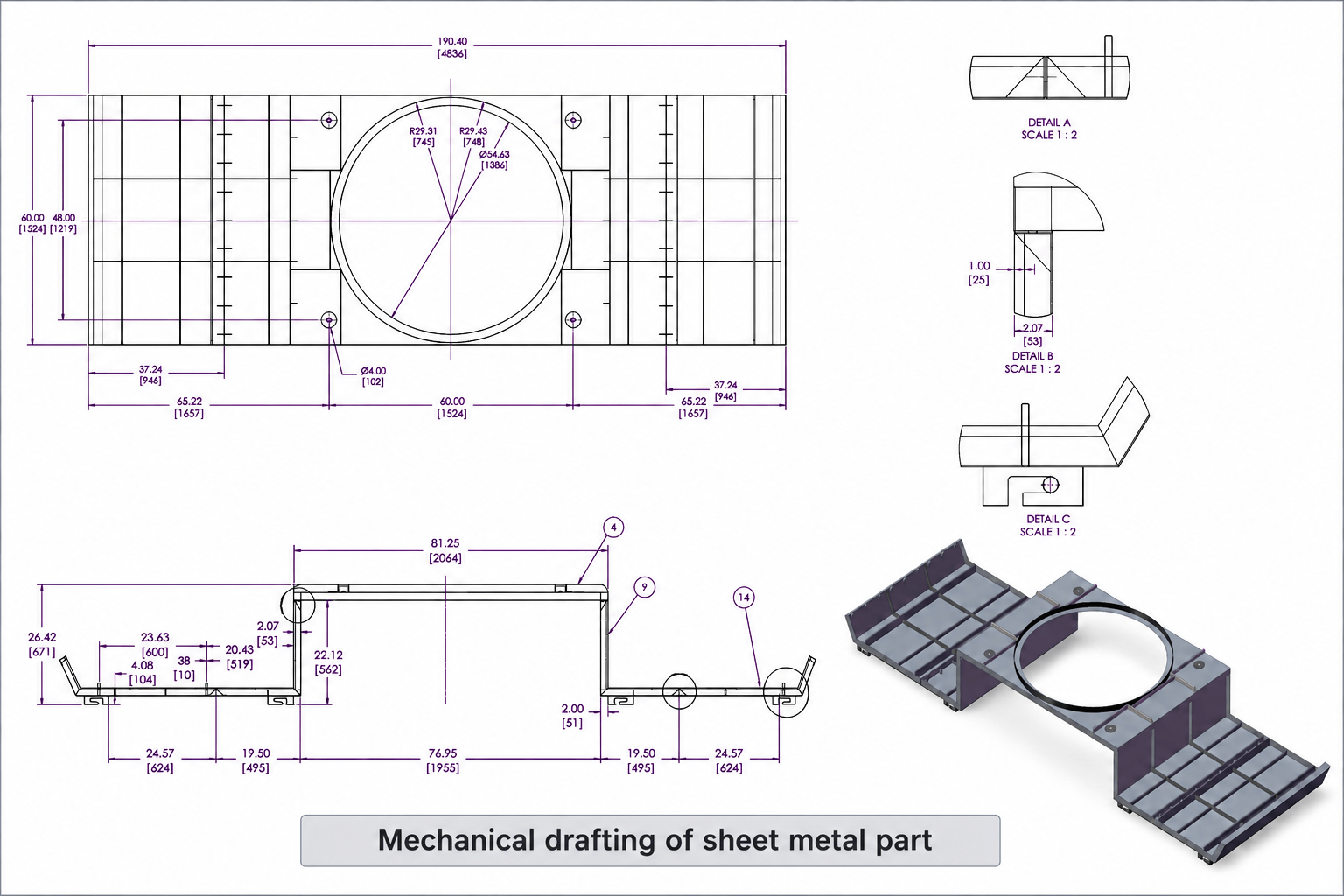
Mechanical CAD drafting services generate a complete set of technical documents that link the creation of a design with the manufacturing of the products.
2D engineering drawings are represented as orthographic projection views, sectional views with dimensioned notes. The application of geometric dimensioning and tolerancing (GD&T) provides the necessary unambiguous specifications for defining geometric tolerances on the form, orientation location and run-out of features and elements within the product.
The use of assembly models verifies whether or not the individual parts are properly aligned and functionally interact with each other prior to actual physical assembly of the parts. Exploded views can be developed to assist in providing the necessary instructions to assemble and maintain the product.
Bills of materials (BOMs) are automatically generated that list the required items including the components, assemblies and purchased parts needed to produce the product. This supports production planning and purchasing functions of the organization.
Following table sums the deliverables and the way they help:
| CAD deliverable | Primary function | Manufacturing application |
|---|---|---|
| CAD deliverable Parametric 3D models | Primary function Master product definition with design relationships | Manufacturing application FEA analysis, CNC programming, additive manufacturing |
| CAD deliverable 2D engineering drawings | Primary function Manufacturing documentation with dimensions | Manufacturing application Setup machining operations, quality inspections |
| CAD deliverable GD&T specifications | Primary function Unambiguous geometric tolerance control | Manufacturing application CMM inspection, fixture setup, tolerance verification |
| CAD deliverable Assembly models | Primary function Verify alignment and motion characteristics | Manufacturing application Assembly sequence planning, interference checking |
| CAD deliverable Exploded views | Primary function Disassembly sequence visualization | Manufacturing application Assembly instructions, service documentation |
| CAD deliverable BOMs | Primary function Complete material and component listing | Manufacturing application Production planning, procurement, cost estimation |
How CAD drafting services improve mechanical product design workflows
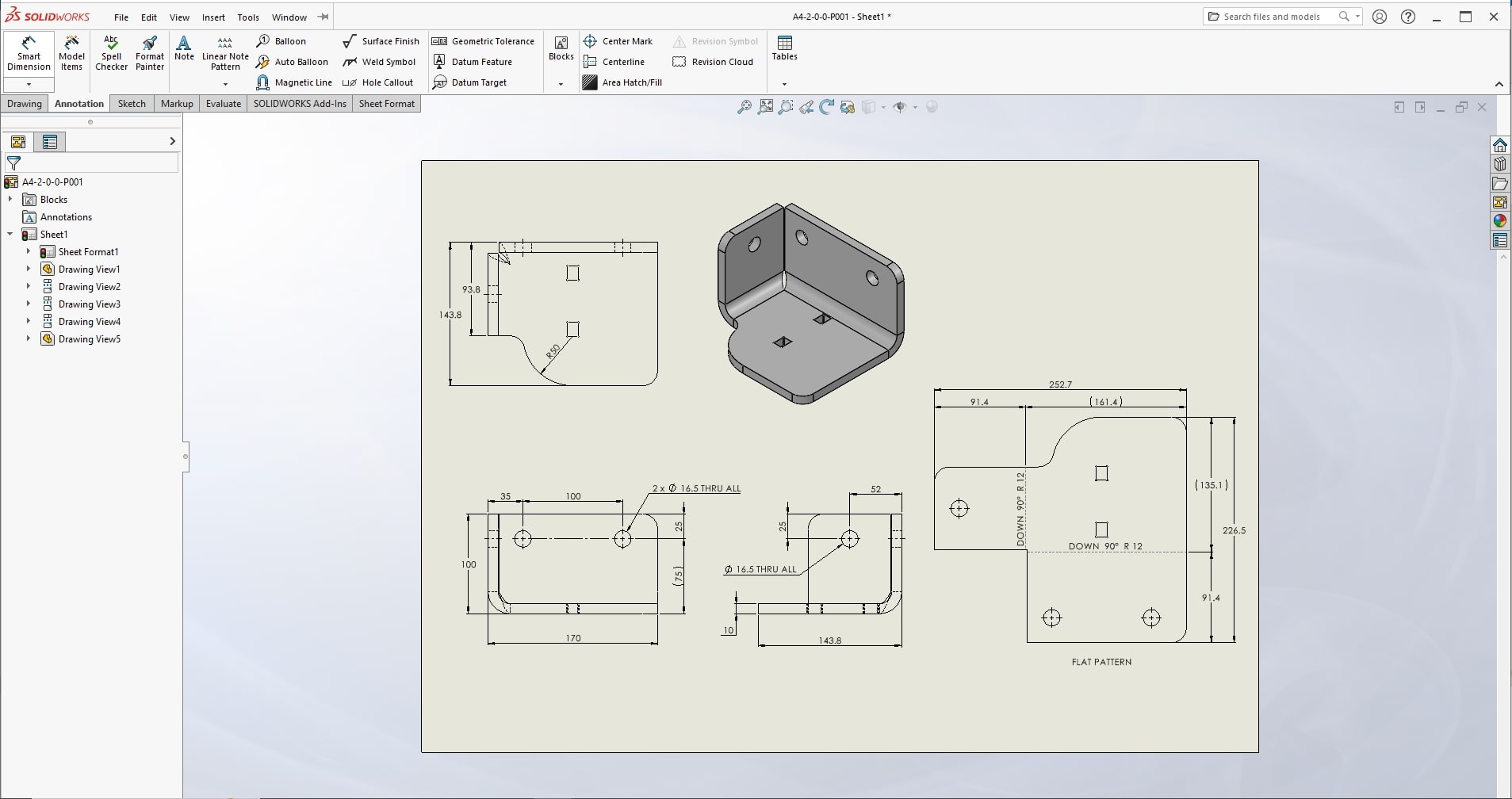
CAD technologies have changed the way mechanical designs are executed in a very fundamental way. The advanced CAD tools and methods used by CAD designing services provide the most efficient, accurate and collaborative environments for engineers.
CAD tools improving mechanical product design
CAD software for mechanical engineering represents parts using solid modeling kernel as volumetric bodies which define the boundary of materials. Boolean operations combine these to produce complex geometric shapes by adding or subtracting volumes.
Parametric modeling allows rapid updating of designs. A mounting bracket can be created that has parameters for bolt spacing. When the spacing is changed from 100mm to 120mm, all related geometry is updated automatically.
CAD drafting automation tools accelerate the production of drawings by automatically generating orthographic views of a 3D model and applying dimensional annotations automatically.
CAD Library Management permits the reuse of standardized components. Engineers use the library to obtain standard bearing assemblies instead of creating them from scratch, greatly reducing design time.
3D Model-based definition (MBD) includes manufacturing information directly in 3D models. Dimensions, tolerances and surface finish are included in the model environment eliminating the need for a second 2D drawing.
Advanced CAD workflows supporting manufacturing and product optimization
CAD drafting for mechanical product design uses structured workflows to generate production-ready documentation. As an engineer follows the sequence of layout sketch, detail model creation, drawing generation and document release, they are creating a complete package with all necessary elements that will be transferred to manufacturing.
This is used to enable the efficient manufacturing design handoff process. The complete packages contain a 3D model, 2D drawings, Bill of Materials (BOM), material specifications and quality control checklists to ensure no details are omitted in the transition.
Reverse engineering CAD workflows allows engineers to create manufacturable CAD models based on physical samples of legacy parts.
CAD conversion services allow engineers to convert legacy drawings into modern editable formats. The raster-to-vector conversion is a technique that scans a legacy drawing and converts it into editable geometry, while reconstructing parametric features.
Product design lifecycle optimization provides the ability to manage design data across the product lifecycle, regardless of how much the product evolves. The configuration management process ensures that only specific design versions are used in production, enabling the ability to track different versions.
Some key benefits of improved workflows include:
- Design-for-manufacturing analysis that identifies problem areas such as thin walls that may be difficult to mold and/or deep pockets that may be difficult to machine prior to production
- Assembly checks that verify components can be assembled via a feasible motion path without requiring special tooling or fixtures
- Automated document packages that provide a complete hand off package containing models that can be used for fixture design and inspection planning
- Revision control that tracks the changes made to designs over time, documents the reasoning behind those changes and maintains a record of previous revisions
2D Drawing to 3D CAD Modeling for an Industrial Tool Manufacturer
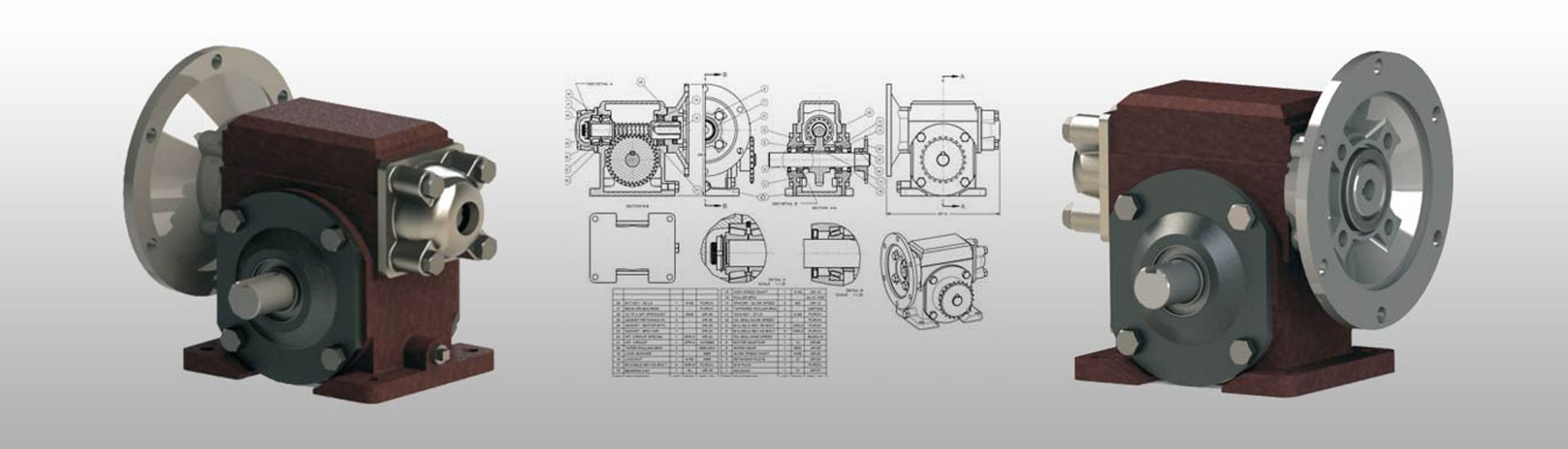
A tool manufacturer from India used legacy 2D drawings in PDF format and therefore had difficulty updating designs. This limited ability to collaborate with shop floor personnel and slowed down all engineering processes when making changes to the reducer gear assemblies used in steel strapping machines.
Hitech Engineering Services analyzed the 2D drawings and the capability of the shop floor to produce the parts, created detailed 3D CAD models of the reducer gear assembly. Our CAD drafting experts generated manufacturing drawings, bill of materials (BOM’s), and exploded views to improve communication among the design engineers and manufacturing team members.
The end results were:
- Shorter turnaround time for design update requests
- Improved communications among the engineering and manufacturing groups
- Established a base for future design modification using 3D CAD
Business benefits of outsourcing mechanical CAD drafting services
Outsourcing CAD services to engineering firms provides both strategic and operational value. The organization is able to utilize the skills of a third-party company as opposed to building and maintaining these capabilities within their own organization.
CAD Drafting advantages for product design gained by outsourcing to CAD services for mechanical products include:
- Improved engineering efficiency through the utilization of specialized drafters whose sole focus is modeling, thereby creating an expert base in software capabilities and drafting standards.
- Reduced product development time through the use of flexible staffing models which allow organizations to scale up their resources based upon project demand, particularly during peak project times.
- Reduced design errors through the use of standardized quality processes which include peer reviews, checking procedures and validation protocols to identify errors prior to release.
- Increased productivity through the use of automation tools, template libraries and reusable components which reduce the amount of time it takes to create drawings substantially.
- Enhanced collaboration through the provision of professional documentation eliminating ambiguity and clearly communicating the design intent to various stakeholders.
- Lower manufacturing errors through the rigorous checking process that verifies dimensional completeness, ensures GD&T consistency and validates assembly feasibility.
- Scalability for complex projects through the ability to rapidly adjust resources without the permanent overhead costs associated with expanding full-time staff.
- Operational cost savings when you outsource mechanical CAD drafting where the provider maintains the necessary infrastructure, documented processes and quality control procedures, thus reducing the need for clients to invest in additional capital resources.
Conclusion
Mechanical CAD design services provide a foundation for product design. CAD is be used to create a digital model of a part or assembly in mechanical product CAD design with the ability to define the geometry precisely and to generate manufacturing ready documentation.
Engineering design communication tools are available to support collaborative efforts and complete analyses among extended teams. Advanced workflows integrating Model Based Definition (MBD), automated documentation and other process improvements enhance the process of creating a product.
Companies who implement CAD capabilities benefit from faster design times and improved design quality.

 Feb 28th, 2024

Leave a Reply